Success Indicators to Be Applied to the Overall Objective: The Threads Running Through Everything
The previous section focused on the three specific objectives of the new devis.
This section is different.
These elements – autonomy, strategy use, progression, and openness – are not separate competencies to be taught in isolation. They are meant to be infused into everything you do:
- when students interact
- when they write
- when they reinvest their understanding
They shape how learning happens, not just what is learned.
Autonomy & Self-Regulation
At the heart of the new devis is a simple but powerful idea: Students should not just complete tasks – they should take ownership of their own learning.
It shows how autonomy develops through:
- goal-setting
- strategy use
- reflection
- feedback and adjustment
It also provides concrete ways to evaluate it, such as:
- annotated work that shows thinking
- self-assessment aligned with evaluation grids
- revision tasks based on feedback
It introduces different types of strategies (cognitive, metacognitive, social, affective) and shows how to integrate them into everyday tasks.
Rather than simply assigning activities, teachers are encouraged to:
- model strategies explicitly
- guide students through practice
- build in moments for reflection and transfer
The goal is for students to begin seeing progress as something they can influence – not something fixed.
Progression
One of the most important shifts in the new devis is the move from performance to progress.
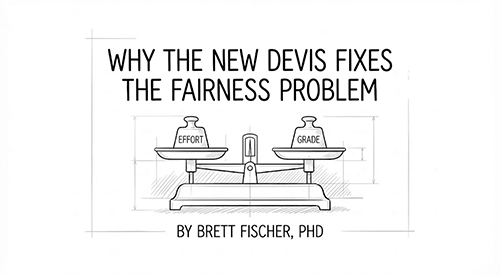
It shows how progression can be built into a course through:
- checkpoints before major evaluations
- feedback that students can act on
- opportunities for revision and reattempt
It also addresses a key issue in CEGEP classrooms: fairness. Students do not start at the same level—but they can all demonstrate meaningful growth.
Grammar as a Tool for Meaning
The new devis make something explicit that was often misunderstood before: grammar is not an end in itself.
Students are expected to develop control over language forms in order to communicate clearly, precisely, and appropriately across contexts, tasks, and levels.
But what does that actually look like in practice?
Openness, Respect & Curiosity
The new devis make something explicit that was often implicit before:
Students are expected to demonstrate openness, respect, and curiosity toward other cultures in every course, at every level, in both A- and B-blocks.
But what does that actually mean in practice?
It addresses questions such as:
- What does it mean to engage respectfully with different perspectives?
- How can students show curiosity rather than judgment?
- How can tasks be designed to foster meaningful intercultural exchange?
It also provides guidance on how to:
- create safe but challenging spaces for discussion
- support students in navigating disagreement
- evaluate openness in observable, fair ways

podcast RASCALS’ Roundtable Podcast S1E13: Open to Debate Featuring: Mikhael Kowalak (Cégep de Sherbrooke)
In this episode, we tackle one of the most quietly controversial aspects of the new devis: How do we teach and evaluate openness? Mikhael Kowalak shares real classroom experiences and explores how to assess openness in discussions, how to handle conflicting viewpoints, and how to balance pedagogical goals with ethical considerations.
From grading debates to navigating moments of cultural tension, this episode brings nuance, honesty, and practical insight to a complex issue.
Final Thought: What Ties It All Together
If the three objectives define what students do, these elements define how they grow while doing it.
They remind us that:
- learning is a process
- progress matters
- strategies can be taught
- and communication always happens between people, not just languages
These are not extras – they are the foundation of the new devis.
Continue exploring or move to Apply to see how these ideas translate into concrete tools and classroom practices.